Types of Educational Content Developed with Virtual Reality (VR)
Exploring the Applications of Virtual Reality in Creating Interactive Learning Experiences
Introduction
Virtual Reality (VR) has become one of the most important transformative technologies in the field of education in recent years. By creating three-dimensional and interactive environments, this technology enables users to directly experience educational concepts. In virtual reality, users are not merely observers of information; they become active participants in a simulated environment where they can interact with different elements. This unique capability makes learning deeper, more engaging, and more memorable. In traditional education methods, knowledge is often transferred through text, images, or videos. However, in virtual reality, learners can enter the learning environment, experience different situations, make mistakes, and learn from those experiences. This capability has encouraged many organizations, universities, and educational institutions to adopt VR technology for developing advanced educational content. Virtual Reality enables the creation of various types of educational content, each designed for a specific learning objective. The following sections explore the most important types of educational content that can be designed and developed using VR technology.
Training Simulations
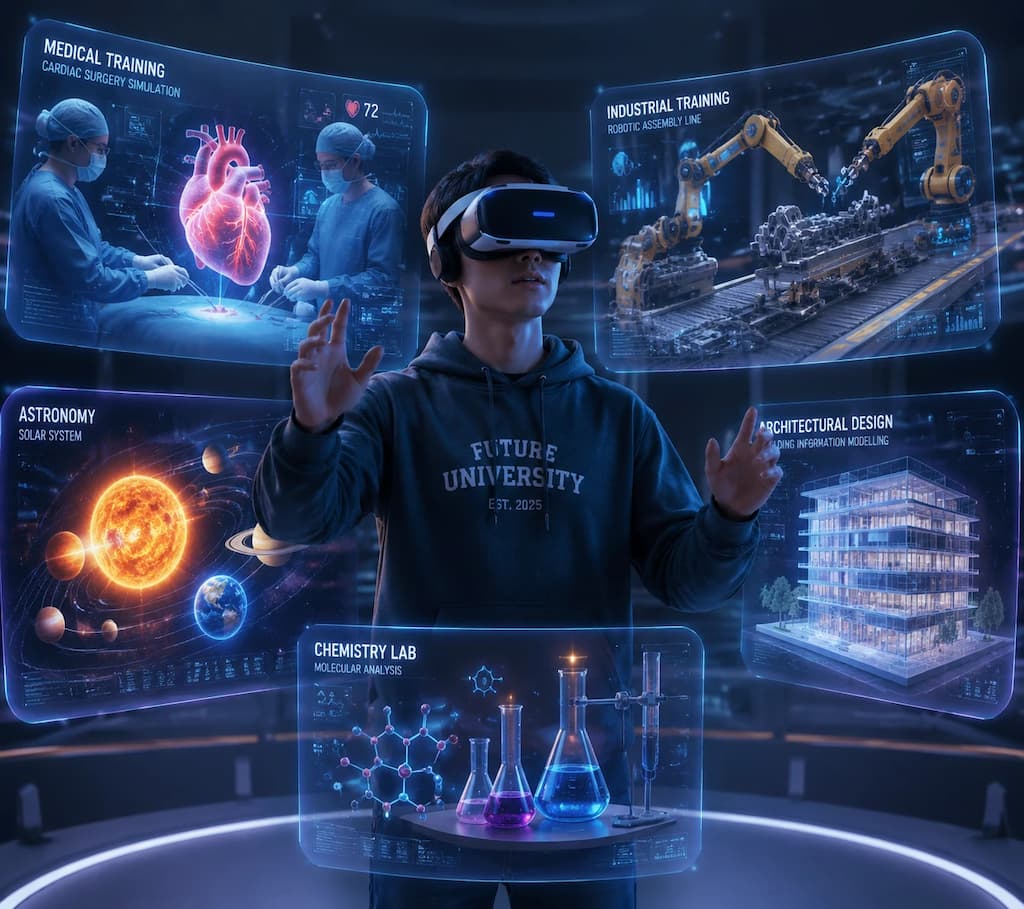
One of the most important and widely used types of educational content in virtual reality is training simulation. In this approach, real-world environments, equipment, and processes are digitally recreated, allowing learners to practice different skills in conditions that closely resemble real situations. Simulations enable users to gain practical experience without being exposed to real-world risks or high operational costs. For example, in the medical field, students can practice different surgical procedures in a virtual environment. In various industries, employees can learn how to operate complex machinery and equipment before entering real operational environments. This type of training improves individual readiness, reduces human errors, and enhances workplace safety. Since simulations can be repeated unlimited times, learners can practice specific skills repeatedly until they achieve the required level of proficiency.
Virtual Educational Tours
Virtual educational tours are another type of VR-based learning content that allows users to explore different locations and environments. Through this type of content, learners can experience places that may be difficult or impossible to access in the real world. For example, students can visit world-famous museums, explore historical cities, or experience ancient sites virtually. Organizations can also create virtual tours of factories, laboratories, and industrial facilities, allowing learners to become familiar with production processes and operational environments. These experiences make educational concepts more tangible and increase learners’ interest and engagement. Virtual tours have extensive applications in fields such as history, geography, tourism, architecture, and archaeology, and can serve as an effective alternative to traditional field visits.
Interactive Scenarios and Decision-Making Training
In interactive scenarios, users are placed in specific situations where they must make different decisions throughout the learning process. These decisions influence the learning path and create different outcomes. As a result, users can observe the consequences of their choices and learn through direct experience. This type of content is highly effective for developing skills such as management, leadership, negotiation, and problem-solving. For example, in a management training scenario, a user may take the role of an organizational manager and face challenges such as employee conflicts, reduced productivity, or organizational crises. The user must decide how to manage these challenges, and each decision leads to different consequences. This training approach allows individuals to improve their decision-making skills in a safe environment while experiencing the potential outcomes of different choices.
Practical and Technical Skills Training
One of the major applications of virtual reality in education is teaching practical and technical skills. In this type of content, users can interact with tools and equipment and practice operational procedures in an interactive environment. For example, technical and vocational training programs can use VR to teach equipment maintenance, component assembly, or industrial machine operation. Users can pick up components, place them correctly, and perform step-by-step procedures in a realistic virtual environment. The main advantage of this approach is that learners can practice their skills without damaging real equipment or creating safety risks. Additionally, the ability to repeat exercises and correct mistakes significantly improves learning effectiveness.
Virtual Laboratories
Virtual laboratories are among the most important applications of VR in science education. In this type of content, laboratory environments are recreated in three-dimensional virtual spaces where users can perform different experiments. For example, in chemistry education, students can combine different materials and observe chemical reactions. In physics, experiments that require expensive equipment can be conducted virtually. In biology, learners can explore the structure of cells or human body systems through interactive 3D models. Virtual laboratories not only reduce educational costs but also allow students to repeat experiments multiple times and gain a deeper understanding of scientific concepts.
Medical and Surgical Training
Virtual Reality plays a significant role in medical education and training. This technology allows medical students to explore the human body through three-dimensional models and gain a more detailed understanding of anatomy. Furthermore, students can practice various surgical procedures in a virtual environment. Through VR-based medical training, learners can perform surgical steps, interact with medical instruments, and experience different clinical conditions. This experience helps future healthcare professionals develop greater skills and confidence before performing procedures in real-world environments.
Safety Training and Crisis Management
Another important application of VR in education is simulating emergency situations and safety training. In this type of content, scenarios such as fires, earthquakes, explosions, or industrial accidents can be realistically recreated. Users learn how to respond during emergencies, avoid hazards, and assist others in dangerous situations. Since conducting such exercises in real environments can be risky, Virtual Reality provides a highly effective solution for safety education and emergency preparedness.
Military and Defense Training
Virtual Reality has been used in military training for many years. In this field, virtual environments are used to simulate battlefields, train operational procedures, and practice the use of different equipment. This technology enables military personnel to train in highly realistic conditions without creating significant costs or real-world risks. Different scenarios can also be designed to prepare personnel for various operational challenges and situations.
Soft Skills Training
Soft skills such as effective communication, stress management, teamwork, and negotiation are among the capabilities that usually require practical experience to develop. Virtual Reality can create environments where individuals interact with virtual characters and practice these skills. For example, an employee can practice handling a difficult customer conversation, or a manager can experience delivering a presentation to a virtual audience. This type of training improves confidence and enhances communication abilities.
Architecture and Design Education
In architecture and design, Virtual Reality enables users to experience designed spaces before construction begins.Architecture students can enter three-dimensional building models and experience spaces from the perspective of real users. This experience helps them better understand scale, lighting, spatial arrangement, and user experience. Additionally, different design concepts can be evaluated and modified before project implementation.
Earth Science and Environmental Education
Virtual Reality can also be highly valuable for teaching natural phenomena and environmental concepts. Through VR-based content, users can explore environments such as forests, oceans, mountains, and polar regions while learning about different ecosystems. Natural events such as volcanic eruptions, earthquakes, and climate changes can also be simulated and experienced interactively. This immersive experience enables students to gain a deeper understanding of natural processes.
Astronomy and Space Education
Virtual Reality provides an opportunity to experience space and the solar system in ways that traditional educational methods cannot offer. Users can travel among planets, explore planetary surfaces, or experience space stations virtually. This type of content helps students better understand astronomical concepts and develop a clearer vision of the universe.
Art and Creativity Education
In the field of art, Virtual Reality has introduced new opportunities for learning and creative expression. Artists and art students can paint in three-dimensional environments, create digital sculptures, or design immersive artistic spaces. This technology allows creators to bring their ideas to life in fully interactive and creative environments while gaining new experiences in the artistic process.
Conclusion
Virtual Reality, by creating immersive and interactive environments, has transformed traditional approaches to education. This technology enables the development of various educational content types, from professional simulations and virtual laboratories to educational tours, soft skills training, medical education, and artistic experiences. As VR technology continues to evolve and hardware costs decrease, the adoption of VR-based learning is expected to expand significantly across schools, universities, and organizations. Virtual Reality will play an increasingly important role in transforming educational systems and creating more effective, engaging, and practical learning experiences.
Tags: