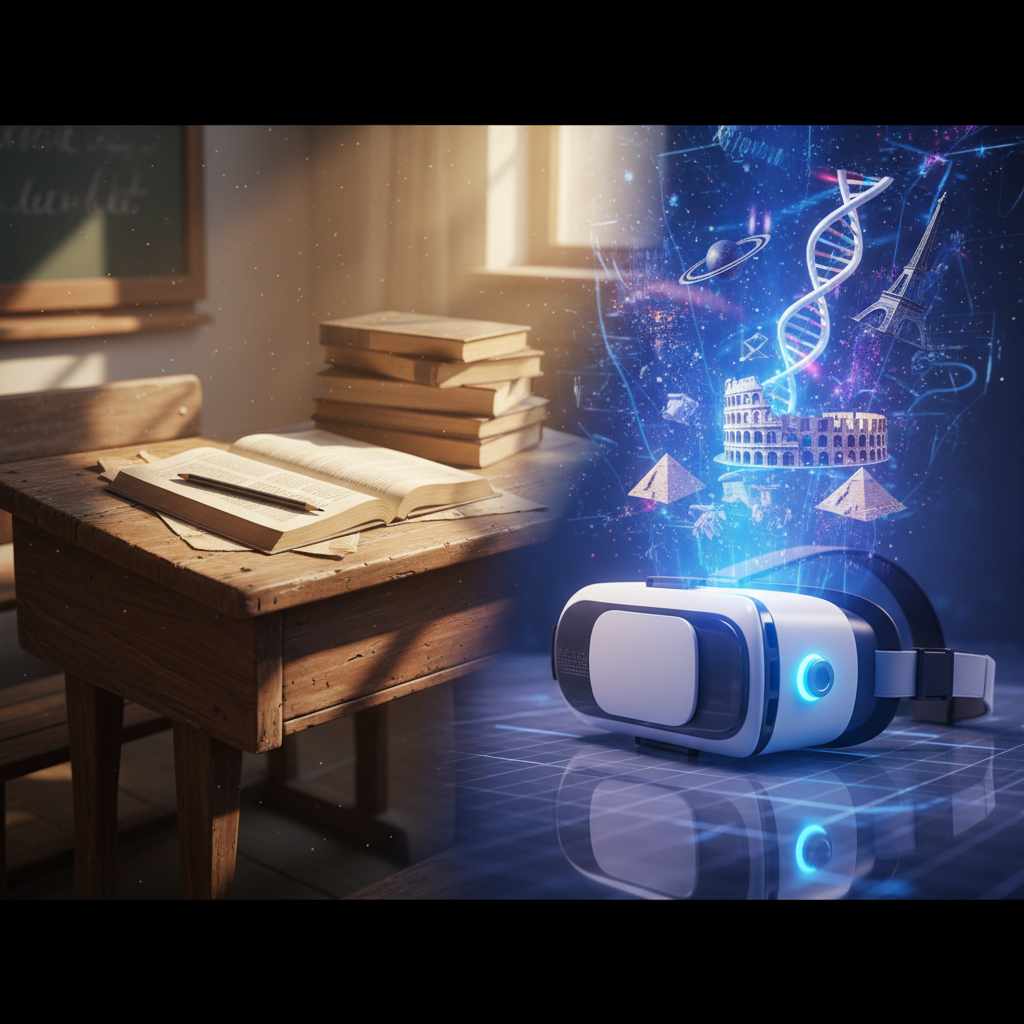
Bridging Traditional Education and Virtual Reality
From the Blackboard to Virtual Reality
Breaking the Physical Boundaries of the Classroom
In today’s world, the concept of education has moved far beyond the four walls of the classroom and the pages of textbooks. We are in the midst of a cognitive revolution, where traditional teaching methods are being challenged by the emergence of Virtual Reality (VR). This article explores the relationship between traditional education and virtual reality and examines how combining these two approaches can help unlock the full potential of human learning.
The Legacy of Traditional Education: A Foundation for Human Interaction
For centuries, traditional education has been built around physical presence, discipline, and face-to-face interaction. One of its greatest strengths lies in creating an emotional connection between teachers and students while fostering social skills through peer interaction. Textbooks and blackboards remain valuable educational tools. They encourage linear thinking, concentration, and sustained attention. However, in today’s fast-paced digital world, these tools alone may no longer be enough to capture the curiosity and engagement of a new generation of learners.
The Rise of Virtual Reality (VR): Beyond Theory, Into Experience
Virtual Reality transforms education from an audiovisual process into an immersive, lived experience.
Instead of simply observing or listening to educational content, students can step directly into it. VR engages multiple senses simultaneously, helping bridge the gap between abstract concepts and tangible, real-world experiences. Rather than learning about something, students can experience it.
The Strategic Advantages of VR: Why Is Virtual Reality Becoming Essential?
Alongside traditional educational methods, VR offers capabilities that were previously difficult or even impossible to achieve:
• Visualizing the Invisible: Students can explore microscopic cells or travel through the depths of a black hole—concepts that textbooks can often describe only through words and static images.
• Learning Through Safe Failure: In a VR environment, mistakes can be made without real-world consequences. Students can repeatedly practice complex procedures, such as performing a surgical operation or managing a simulated nuclear reactor, and learn from their mistakes without risking lives, equipment, or financial resources.
• Improved Information Retention: Research suggests that experiential learning in VR can significantly improve long-term information retention compared with traditional lecture-based learning.
• Total Immersion: By reducing environmental distractions, VR places learners inside a controlled environment where their attention can remain focused on the learning experience.
Strengthening Emotional Intelligence and Empathy: The “Empathy Machine”
One of the most powerful applications of VR is its ability to place people in someone else’s position. Through carefully designed simulations, students can experience what it might be like to live in a war zone, navigate life with a disability, or interact within an unfamiliar culture. Often described as an “empathy machine,” VR can transform subjects such as social studies and history from memorization-based lessons into deeply human experiences. Instead of simply reading about another person’s reality, learners can gain a more personal understanding of it.
The Challenge of Educational Equity and Technology Costs
Despite the impressive potential of VR, its challenges cannot be overlooked. Traditional education remains one of the most accessible approaches because of its relatively low cost and limited technological requirements. By contrast, implementing VR requires specialized hardware, reliable high-speed internet, technical infrastructure, and professionally developed educational content. At present, these requirements can create a technological and economic divide, potentially widening existing inequalities in access to quality education.
Hybrid Learning: Building a Bridge Between Two Different Worlds
The logical outcome of this debate is not for one approach to replace the other. Instead, the future lies in Hybrid Learning. In a hybrid learning model, theoretical concepts, analytical discussions, and teacher-guided instruction can take place within the traditional classroom. Students can then enter virtual environments to experiment, explore, practice, and experience concepts in ways that would otherwise be difficult to achieve. In this model, the role of the teacher evolves from simply being a “knowledge transmitter” to becoming a “facilitator of experience.” Technology does not eliminate the teacher’s role. Instead, it gives educators new ways to guide students through deeper and more meaningful learning experiences.
Final Thoughts: Toward a Boundless Future of Learning
Virtual Reality is not a replacement for teachers. Instead, it may become one of the most powerful tools ever introduced into education. The evolution of education depends on recognizing that books feed the mind, while immersive experiences can bring curiosity to life. We are approaching an era in which learning is no longer simply a task or obligation. It can become an endless adventure of exploration, discovery, and experience. The future of education may not be about choosing between the classroom and virtual reality. It may be about bringing the best of both worlds together.
Tags: