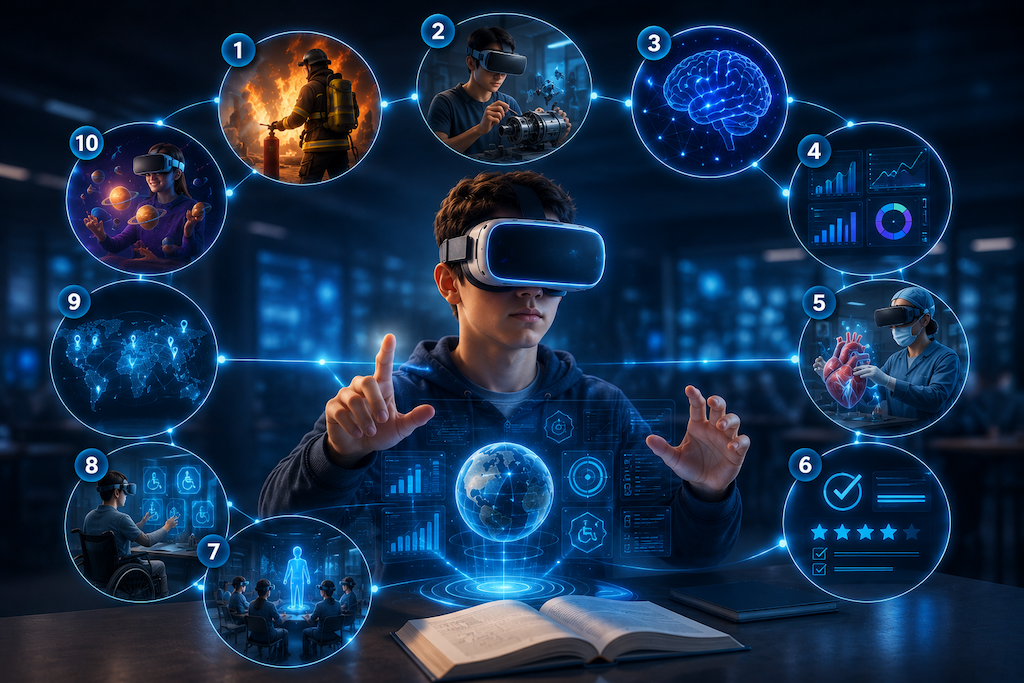
10 Key Benefits of Using Virtual Reality in Training
A Comprehensive Review of the Role of VR Technology in Improving Learning Outcomes
1) Reducing the Cost of High-Risk and Expensive Training Programs
Many specialized training programs require expensive equipment, real operational environments, or conditions that may involve significant safety risks. Virtual Reality (VR) provides a safe and cost-effective alternative for practicing skills that are dangerous, complex, or costly to perform in real-world settings. VR enables learners to develop essential skills in a fully simulated environment without being exposed to actual risks. From operating industrial equipment and performing complex experiments to safety training and emergency response scenarios, various learning activities can be conducted with lower costs and higher levels of safety. This approach not only reduces training expenses but also minimizes the possibility of errors and accidents during the learning process.
2) Skill-Based Learning Through Repetitive Practice Without Classroom Limitations
One of the major challenges of traditional training methods is the limited opportunity for hands-on practice. In VR-based learning environments, trainees can repeat educational activities and scenarios multiple times without requiring access to real equipment, specific physical spaces, or continuous instructor supervision. From industrial equipment maintenance and medical procedures to practicing communication skills in a new language, these activities can be performed efficiently without disrupting classroom environments or consuming additional resources. This continuous and targeted practice transforms learning from a theoretical process into a practical, skill-oriented experience, leading to improved proficiency, fewer mistakes, and stronger knowledge retention.
3) Increasing Cognitive Engagement Instead of Memorization
Virtual Reality changes the learner’s role from a passive listener into an active problem solver. Instead of simply watching demonstrations or memorizing information, learners interact with a simulated environment where they must make decisions, solve problems, and respond to different challenges. This hands-on experience helps learners develop a deeper understanding of concepts and moves education beyond information retention toward analysis, decision-making, and real-world application. As a result, knowledge retention improves significantly, and the overall quality of learning is enhanced.
4) Improving Transfer of Learning to Real-World Environments
One of the primary goals of any training program is the ability to apply acquired knowledge and skills in real situations. Virtual Reality directly addresses this challenge by recreating realistic scenarios and operational conditions. Because VR allows learners to experience situations rather than simply read about or watch them, skills can be transferred more effectively to real-world environments. Compared with traditional methods such as reading textbooks or watching instructional videos, VR has a greater impact on transforming theoretical knowledge into practical and applicable skills.
5) Scenario-Based Training for Decision-Making and Crisis Management
One of the most powerful capabilities of VR is the ability to create realistic and interactive training scenarios. Imagine practicing emergency situations such as firefighting, rescue operations, responding to customer complaints, managing a challenging classroom environment, or making complex ethical decisions—all within a controlled virtual environment. This type of scenario-based training is particularly effective for developing human skills and soft skills. A key advantage of this approach is the ability to immediately observe the consequences of decisions and actions. This transforms learning from a theoretical exercise into a practical, memorable, and experience-driven process.
6) Immediate and Accurate Feedback Instead of Delayed Evaluation
In traditional training methods, learners often discover their mistakes long after completing an exercise or assessment, when the opportunity for effective improvement may have already passed. However, VR training systems can provide immediate and accurate feedback, including information about where an error occurred, which steps were missed, how much time was spent completing a task, and the level of performance accuracy. This real-time feedback enables a faster, more targeted, and more effective learning process.
7) Transforming Training into a Data-Driven Process
One of the key advantages of Virtual Reality is its ability to transform training into a measurable and data-driven process. During each VR training session, valuable information such as practice duration, number of errors, interaction patterns, progress level, and challenging areas can be recorded and analyzed. Through Learning Analytics, training programs can move away from subjective evaluation and become scientific, measurable, and continuously optimized processes. This allows organizations to identify what works effectively and which areas require improvement.
8) Improved Accessibility for Learners with Specific Needs
Virtual Reality can be a powerful educational tool for learners who face specific challenges, such as social anxiety or the need to practice in a fully controlled environment. VR allows these individuals to gradually engage with different situations at their own pace and develop greater confidence. In addition, VR-based learning environments can be customized according to individual needs by adjusting the complexity, speed, and level of interaction, helping learners maintain focus and achieve better outcomes.
9) Standardizing Training Quality Across Different Instructors
In many educational and organizational environments, learning quality depends heavily on the teaching methods and experience of individual instructors. This variation can lead to inconsistent learning experiences. Virtual Reality addresses this challenge by providing standardized and pre-designed training scenarios, ensuring that all learners receive a consistent, accurate, and high-quality experience regardless of the instructor or training location. In VR-based training, educational content, implementation methods, and evaluation criteria remain consistent for all participants. This reduces dependence on individual teaching styles and creates scalable training programs with predictable outcomes.
10) Increasing Engagement and Motivation in Learning
One of the most important benefits of Virtual Reality is its ability to maintain learners’ attention and actively involve them throughout the training process. Unlike many traditional learning methods that may lead to reduced concentration and lower motivation, VR places learners in an interactive and immersive environment where education becomes an active experience. When training content is properly designed, learners participate more effectively, understand concepts more deeply, and use training time more efficiently. As a result, learning becomes not only more engaging but also deeper, more effective, and more memorable.
Tags: